
Business Models: Why Business Models Matter?
Abstract
Why do business models matter? This is a question that seems pertinent and must be answered before embarking on any business. It is quite essential because of the competitive nature of the business space. As a system that has many sub-systems, business models describe how the elements of a business fit and work together. Nonetheless, these elements do not factor in one critical dimension of performance, which is competition, which is the function of the business model. This study clarifies the concept of business model, which is key to the performance of every business. A business model can be identified as a framework or blueprint that a business follows to generate revenue from which profit is earned. It outlines how a company will create, deliver, and capture value for its customers and stakeholders. Since the business model has a perfect correlation with revenue and profit, it is key to the survival and effectiveness of the business. Business models are, at heart, stories that explain how enterprises work. Like a good story, a robust business model contains precisely delineated characters, plausible motivations, and a plot that turns on an insight about value. It answers certain questions: who is the customer? How does business make money? What underlying economic logic explains the delivery of value to customers at an appropriate cost? Every viable organization is built on a sound business model, but a business model is not a strategy, even though many people use the terms interchangeably.
Keywords:BusinessBusiness modelFrameworkSurvival
1. Introduction
When invited to speak at the Massachusetts Institute of Technology (MIT), Richard. K [1], the chairman of ViS Research Kivel, an American multinational company that is a leading health technology business with a presence in 4 different countries, gave a simple definition of a business model. But before I put the definition forward, it is important to note that the emergence of the start-up ecosystem has really improved the conversation around this buzzword, and it has now become the order of the day.
Richard Kivel defined the business model as 'the method by which a firm uses its resources to offer better values to customers than its competitors and make money doing so' [1]. Complexity has been famous for years, but as we move into the era that is driven by technology and the internet, simplicity seems to be the order of the day. Hence, the business model will be considered and analyzed from a simplistic perspective in this piece.
The goal of this study is to achieve the daunting task of simplifying the narratives around why firms (companies and organizations) need to rethink their business models. To achieve that, three major components of this subject will be carefully examined. One would be what the lingo really means-I will take a closer look at how it emanates and the key drivers to its emergence. It is essential to examine how business models can be used to the advantage of a fast-rising firm, especially in a time and age when the lifespan of an average start-up is estimated to be 6 years [2]. This study is purposed at investigating why business models matter and how they can be a competitive advantage to enterprises.
2. Literature Review
Taking a good look at the way firms coordinate their functions shows that business models are generally about the articulation of different areas of a firm's activity designed to produce a proposition of value to customers [3]. Xavier and his colleague argue that the term 'business model' has two different approaches, which can also define how it is used.
The first is the static approach, which is basically about how different parts of a business coherently function to keep the business alive, and the second approach is about how the business can innovate values and transact the values for monetary consideration. The second approach is hence called the transformational approach. One would be persuaded to agree with this assertion because most technology-driven and innovative companies in this generation have leveraged the advent of the term to rethink the elements of their businesses so they can provide unique values to values to the users [4].
Therefore, we will state that a business model is a structural outlook that defines how a business coordinates its work and also trades value for value with customers. Also, we can establish that a business model is "the rationale of how an organization creates, delivers, and captures value" [5].
Although there are many elements of a business model, the subject is best understood by taking a closer look at the three major components:
I. Value creation for customers: this part of the business model explores how a firm identifies the customer segments that are unique to its offering and how it can clearly create products that meet the needs (taking away the pain and offering gains) of the customers.
II. Supply chain and stakeholder networks: this component focuses more on the different drivers of the company's success.
III. Value creation for the firm: this component finally examines how the firm returns value back to itself. This considers how the company makes its money, breaks even, and also becomes profitable.
Martha, E [6] reflects that it is not easy to make significant changes to the way you do business. Ordinarily, this would not have been a challenge to ventures globally if not for the unending change in external environmental factors that beckons internal adjustments to respond to this change.
Once a business figures out its way(s) of doing business and readjusts its internal mechanism in such a way that it can provide values that competitors can not catch up with, it is said that it has a better business model. The advantage here is that businesses enjoy exclusivity to their business model innovation for a long time because of the first mover's advantage [7].
3. Product Innovation versus Business Model Innovation
So, the first question is this: In the search for this new mechanism or order of doing business, what are the immediate pitholes? One of the major challenges executives face is a decision that is often made unconsciously. The trade-off between building new plants, creating new products and processes, etc, against innovating a new business model. It is always important to mention that the business model is not the business, so most often, business leaders do not think in this direction.
For instance, it is typical of start-up entrepreneurs and founders to be locked in the engineering of their product and design, romancing the innovation and not the model that will drive how the value will get to the customers. However, the dynamics are changing as companies recognize that business model innovation is the new form of innovation. To buttress this point, IBM conducted a global study that engaged about 800 business leaders in both the public and private sectors in innovation. The result of the study summarizes that "competitive pressures have pushed business model innovation much higher than expected on CEOs' priority lists" [8].
In this study, businesses whose executives have been more concerned about business model innovation recorded wider operating margins by almost two (2) times higher than their counterparts in the last five years.
3.1 What is Business Model Canvas
To better understand the concept of business models, we will also examine the different types of business models that exist out there, especially for the fast-rising, new-generation businesses. First, let us establish that every business has something that looks like a business model. Remember that from our definition, we mentioned that a business model is how a business coordinates its work and also trades value for value with customers. Therefore, it would be right to say that a business model is some universal concept and that every business has one.
What often makes the difference is how firms use these business models to innovate products and strategies, communicate values to their stakeholders, and simplify their value interaction with their employees. Firms already understand these connections between elements in a business because they ordinarily exist without any educational interventions [9], but scholars, over the years, have looked at how to make these connections more explicit and leverage them to achieve different objectives. This endeavor can support different dimensions of the firm [8], [11], [12].
When a firm clearly understands its business model, then it can innovate to meet the needs of customers within its defined reach, and the first benefit of a clear and explicit business model is that firms can avoid innovation creep. This can also support strategy development and help capture values that are not easily traced or noticed but are advantageous to the growth and transformation of the firm. The business model canvas is shown in Table 1.
When the connections that exist between a business are made explicit through business modeling, it becomes easy to take a better look at the organization's value creation cycle and also analyze every component of what makes the firm deliver its value. Hence, the company can totally eliminate the non-value-add, increasing its bottom line. Also, this endeavor helps capture values that are not seen and discover new opportunities. Usually, this changes the way businesses operate in every industry [13].
Table 1. Business model canvas.
This table is shown in the PDF version of the article.
Therefore, a business model canvas is a tool that helps firms look at their business using the inside-out approach. This approach examines the current interdependencies that exist among the components of the business. The business model canvas designed by Osterwalder and Pigneur [5] helps firms visualize different elements of their business, and it can also be used to gain the input of employees and other stakeholders because of its simplicity. Using this as a visual tool can help represent the different elements and analyze how the elements can be used to create more value for both the customers and the firm [14]. As a communication tool, a team can also use this to discuss and debate products and innovation among teams during brainstorming sessions [15].
For instance, Table 2 illustrates the Google business model with consideration to the 9 elements that make up the Osterwalder and Pigneur [5] BMC.
Table 2. Google business model.
This table is shown in the PDF version of the article.
3.2 Why Business Models Are Important
Having established what a business model is and what it is not, the second most important question that has flooded the business ecosystem is why it is so important. In my experience working with a venture capital firm in Nigeria as the head of one of the biggest incubators, I realized that the term 'business model' has become a buzzword, especially among investors who are trying to understand how the business will self-sustain. So, to take a clue from our already established line of thought, winning in the competitive market is one of the most important things to every business leader, but businesses seem to have only two options in this race for survival.
The first is to keep innovating what we refer to as the 5 Ps- programs, products, processes, principles, and practices or to choose the second alternative, which is to simply shift the energy for innovation to the interconnectedness and interdependence of the activities that determine the way the company "does business" with its customers, partners, and vendors- the phenomenon that is referred to as Business Model Innovation. The former requires a huge investment in creating a new line of products and infrastructure (and there seems to be no guarantee that these are not replicable by competitors).
So, a better way is to keep innovating the business activities in such a way that it satisfies the perceived needs of the market and other parties(the company, its partners, and vendors) and ultimately creates a special return on investment for the business [7]. Hence, we will delve into how business models inform the three most important elements of what keeps executives awake.
4. Business Model: How it Informs Product Innovation
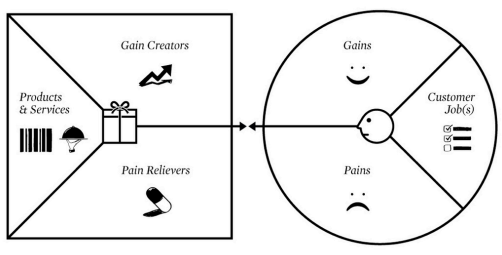
More often than not, companies try to lead in the marketplace by constantly looking for an edge in the competition, and this edge must be sufficient enough to help them lead in the market. Hence, organizations are continually looking for innovations (either in the form of a product or a service). The value proposition canvas is shown in Fig. 1. The challenge of every organization is not just to innovate but to have an innovation that is enough to lead in the market. Hence, innovation is considered appropriate if it achieves these three major objectives:
I. Customer jobs: this segment of the value proposition canvas explores the problem that the customers are trying to solve in their lives and work, and this component is best understood by considering two major ends.
II. The pain the value which will be proposed is intended to solve. A better understanding of the pain will help the company create direct values that the customer can easily identify with and part money for.
III. The gains describe the outcome benefits, which the customer requires, expects, desires, or
will be surprised by. This includes functional utility, social gains, etc. These customer jobs can have social, emotional, and functional intent.
4.1 A Case to Consider
Take the case of a leading online shoe and clothing retailer based in Las Vegas, Nevada. Zappos, in 2009, during the global financial crisis, was acquired by Amazon for a stock worth US$807 million and US$40 million in cash. How Zappos used VPC to provide value to the customers is shown in Table 3. An analysis of the company from the perspective of a 'business model' tells that innovation does not have to be technical. The company stood out (innovated) around three different elements, which are basically informed by the concept of the value proposition canvas.
Firstly, the early team found that selling shoes online was a very difficult task because customers always wanted to try many alternatives before coming to a buying conclusion. And to build an online retail company around that known truth was a suicide mission. However, an understanding of the customer's job and pay helped inform a business model that offers the customer an opportunity to order as many shoes as they want, try different shoes, and return any that do not fit well at no cost. This model worked well, although not without glitches. Using the value proposition canvas, the company focuses on the three crucial components.
Table 3. How Zappos used VPC to provide value to the customers.
This table is shown in the PDF version of the article.
Customer Job The customer finds it very difficult to get a feel for the shoes when they are ordered online. The customer wants the shoes delivered quickly and wants the right fit.
Pain The pain of returning after delivery, choosing the wrong shoes, etc.
Gain The gain of getting exactly what is needed at the right time. The feeling of being able to order for varieties and choose one of many.
6. Business Model: How it Informs Competitive Strategy
Porter's generic [16] strategy argues that organizations need to create a sustainable competitive advantage to survive in the market. He proposes two extremes; the first is differentiation as a competitive choice, and the second is low-cost leadership, which does not necessarily mean low price. However, the narrative of this strategy has been exemplary of business model innovation, which has been made possible by new-generation businesses. In order to analyze this appropriately, we will look at how business model innovation helps to shape strategy.
This popular framework proposed that firms must make the hard choice of whether to stay in the broad or narrow market segment. To best serve these two different market ends, business leaders must choose to either be perceived as a unique or low-cost solution. Then how have innovative (technology companies) decided to do this? Let's consider the case of Uber, a taxi-hailing company. The firm's competitive strategy is low-cost and has a broad market focus. Taking a glance at the canvas again, one would realize that the business leverages the large market and narrows its model to using the partnership to scale its presence. Table 4 and Table 5 give a quick insight into this narrative.
Table 4. Core elements of the Uber business model and its competitive strategy.
This table is shown in the PDF version of the article.
Customer segment Broad market: payment by cash and card Channels Technology and the Google Map Customer relationship Driver's rating Partners First: Google Second: mobile telecommunication company Third: drivers Cost structure 25% to the Uber and 75% to the drivers A firm's business model can provide clear insight into how its corporate strategies align and the actions it needs to take to achieve its strategic objectives. Committing fully to thinking strategy in the light of the business model helps integrate the functionalities of the business with the strategies it has created to win in the marketplace [17].
Table 5. Understanding Uber's business model using the BMC.
This table is shown in the PDF version of the article.
7. Business Model: How it Informs Business Capabilities
Another unique aspect of how business models can be used to the advantage of a firm is 'business capabilities.' Johnston [18] mentions that companies need to be careful of 'Capabilities Myopia,' which is defined as not identifying the need to develop competencies, capabilities, and resources to create new value propositions continuously. Firms can certainly lose value if it is not adequately sensing building and leveraging on opportunities [19]. And to avoid capabilities myopia, firms need to build more agility.
"Strategic Agility is defined as "the ability to dynamically revise or reinvent the company and its strategy" [20]. Agility in this context refers to critical elements of the business model- key resources, key processes, and key partners. Hence, it is important to consider the subject of capabilities from three different dimensions:
I. Response to change: Johnson et al. [13] established that thriving businesses must recognize when they need to change. Hence, companies need to keep strengthening the ability of their business processes and human capital to identify change triggers and also be ready to change. More often than not, change leads to more strategic opportunities and can also be about mitigating risk, which would have cost the company a lot of resources [21]. Also, companies need to keep adjusting their business model in response to industry, revenue generation framework, and social impact innovation [22].
II. Capability to execute: the focus here is to consider the most important component of the business model and build the capabilities to succeed. Also, the firm needs to develop the capabilities of the people to be able to identify needs, implement projects, and achieve high-quality service delivery. This ability will ordinarily be about spotting changes to technological demands. Also, capabilities need to include how people overcome inertia and recreate structures to adapt to the changing demands [23].
III. The relationship for scale: Business managers also use business models to integrate scale into their approach.
First, this approach examines the number of products or services that need to be sold to have a break even. Secondly, this approach also examines the link between the value proposition and the customer. Often, this link is about a channel. So, business executives who consider this link important invest considerably in this. Another key element that helps scale is 'partnership.' The emphasis is on 'key'. Firms tend to identify the gap in this partnership and invest(financially and emotionally) in this to help win in areas that are considered reasonable.
8. Conclusion
In this short piece, we have explored the subject of business models with an emphasis on how firms are using them to innovate value, strategies, and capabilities to best compete in the market. Firms that manage to analyze and reinvent their business models over time often unveil a new opportunity and, more often than not, enjoy the first-mover advantage. Importantly, the link between business model innovation and strategy competition would be of great consideration for future study.
References
- [1] Richard, K. (2016). Business models (Session 2, Part 2). MIT opencourseware. https://www.youtube.com/watch?v=b9Yyj3htBLE&t=2059s
- [2] O’Reilly, L. (2016). The average lifespan of an ad tech company is just 6 years. Business insider (India). https://www.businessinsider.in/the-average-lifespan-of-an-ad-tech-company-is-just-6-years/amp_articleshow/53270463.cms
- [3] Demil, B., & Lecocq, X. (2010). Business model evolution: in search of dynamic consistency. Long range planning, 43(2), 227–246. DOI: 10.1016/j.lrp.2010.02.004
- [4] Adeniran, A. O., Jadah, H. M., & Mohammed, N. H. (2020). Impact of information technology on strategic management in the banking sector of Iraq. Insights into regional development, 2(2), 592–601. DOI: 10.9770/IRD.2020.2.2(7)
- [5] Osterwalder, A. (2010). Business model generation: a handbook for visionaries, game changers, and challengers. John wiley & sons. https://books.google.com/books?id=UzuTAwAAQBAJ
- [6] Mangelsdorf, M. B. (2012). Why its so hard -yet exciting- to rethink your business? MIT sloan management review. https://shop.sloanreview.mit.edu/store/why-its-so-hard-r-yet-exciting-r-to-rethink-your-business
- [7] Amit, R., & Zott, C. (2010). Business model innovation: creating value in times of change. IESE business school working paper, Spain, (870). DOI: 10.2139/ssrn.1701660
- [8] Pohle, G., & Chapman, M. (2006). IBM’s global CEO report 2006: business model innovation matters. Strategy & leadership, 34(5), 34–40. DOI: 10.1108/10878570610701531
- [9] Teece, D. J. (2010). Business models, business strategy and innovation. Long range planning, 43(2), 172–194. DOI: 10.1016/j.lrp.2009.07.003
- [10] Chesbrough, H., & Rosenbloom, R. S. (2002). The role of the business model in capturing value from innovation: evidence from Xerox Corporation’s technology spin‐off companies. Industrial and corporate change, 11(3), 529–555. DOI:10.1093/icc/11.3.529
- [11] Amit, R., & Zott, C. (2010). Business model innovation: creating value in times of change. IESE business school working paper, spain, (870). DOI:10.2139/ssrn.1701660
- [12] Schaltegger, S., Lüdeke-Freund, F., & Hansen, E. G. (2012). Business cases for sustainability: the role of business model innovation for corporate sustainability. International journal of innovation and sustainable development, 6(2), 95–119. DOI: 10.1504/IJISD.2012.046944
- [13] Johnston, K. (2009). Extending the marketing myopia concept to promote strategic agility. Journal of strategic marketing, 17(2), 139–148. DOI: 10.1080/09652540902879292
- [14] Bocken, N. M. P., Short, S. W., Rana, P., & Evans, S. (2014). A literature and practice review to develop sustainable business model archetypes. Journal of cleaner production, 65, 42–56. DOI:10.1016/j.jclepro.2013.11.039
- [15] Wallin, J., Chirumalla, K., & Thompson, A. (2013). Developing pss concepts from traditional product sales situation: the use of business model canvas. Product-service integration for sustainable solutions: proceedings of the 5th cirp international conference on industrial product-service systems, Bochum, Germany. (pp. 263–274). DOI: 10.1007/978-3-642-30820-8_23
- [16] Porter, M. E., & Strategy, C. (1980). Techniques for analyzing industries and competitors. Competitive strategy. New york: free, 1. https://s3.us-east-1.amazonaws.com/storage.thanksforthehelp.com/qfile/porter-michael-e-1980-extract-competitive-strategy-vyr2a2bw.pdf
- [17] Casadesus-Masanell, R., & Ricart, J. E. (2010). From strategy to business models and onto tactics. Long range planning, 43(2), 195–215. DOI: 10.1016/j.lrp.2010.01.004
- [18] Axon, Y. L., Elisa Friedman, A. J. M. (2019). Leading for today and tomorrow: capabilities for a changing world. https://www.harvardbusiness.org/wp-content/uploads/2019/09/21325_CL_LeadershipCapabilities_White_Paper_Digital_Sept2019.pdf
- [19] Teece, D. J. (2007). Explicating dynamic capabilities: the nature and microfoundations of (sustainable) enterprise performance. Strategic management journal, 28(13), 1319–1350. DOI: 10.1002/smj.640
- [20] Fartash, K., Davoudi, S. M. M., & Semnan, I. (2012). The important role of strategic agility in firms’ capability and performance. International journal of engineering and management research, 2(3), 6–12.
- [21] DaSilva, C. M., & Trkman, P. (2014). Business model: what it is and what it is not. Long range planning, 47(6), 379–389. DOI: 10.1016/j.lrp.2013.08.004
- [22] Giesen, E., Berman, S. J., Bell, R., & Blitz, A. (2007). Three ways to successfully innovate your business model. Strategy & leadership, 35(6), 27–33. DOI: 10.1108/10878570710833732
- [23] Wirtz, B. W., Schilke, O., & Ullrich, S. (2010). Strategic development of business models: implications of the web 2.0 for creating value on the internet. Long range planning, 43(2), 272–290. DOI: 10.1016/j.lrp.2010.01.005