
Integrating AI Tools in Spanish Language Classroom: A Practical Analysis of Student Interaction, Challenges, and Pedagogical Strategies
Abstract
The growing presence of Artificial Intelligence (AI) in foreign language teaching has opened up new possibilities for improved teaching methodologies and learners engagement. The paper presents a practical analysis of AI-powered tools in beginner-level Spanish language classrooms, drawn heavily from the author own classroom teaching experiences. It examines how students interact with AI-driven applications, challenges they face, and therefore strategies for its effective pedagogical integration. The study focuses at three key levels: 1) Student Interaction with AI Tools: It analyzes how learners use popular platforms such as Duolingo, ChatGPT and Google Translate for vocabulary building, grammar corrections, and conversational practice or solving a specific problem at hand, 2) Challenges and Limitations: It looks at the concerns such as too much dependence on AI-generated translations, error in automated responses, and the need for cultural and contextual nuances and 3) Pedagogical Strategies: It explores ways in which educators can integrate AI effectively to complement, rather than replace, traditional teaching methods. The classroom observations and the survey done with the learners highlighted both the benefits and the possible drawbacks of AI’s unregulated presence in language learning. The survey findings reinforced the educator’s classroom observation that while AI tools offer personalized learning experiences and instant feedback, they must be supplemented with human-led instruction. Balancing AI automation with meaningful student engagement is the key to ensure effective learning.
Keywords:Spanish languageArtificial intelligenceLanguage learningDigital toolsClassroom pedagogyLearner
interactions, Artificial intelligence challanges.
1. Introduction
The use of Artificial Intelligence (AI) in foreign language learning has opened up new possibilities for enhanced teaching methodologies and learners engagement [1], [2]. This paper presents a practical analysis of AI-powered tools in beginner-level Spanish language classrooms through the paper’s author own classroom teaching experiences and a learner survey. It was felt necessary to examine how students interact with AI-driven applications, the challenges they face, and therefore to come up with strategies for its effective pedagogical integration [3].
The study focuses on three key elements: first, learner’s interaction with AI Tools. Second, Challenges and Limitations. Third, Pedagogical Strategies. To look at these aspects, the paper drew form the classroom observations by the author as a Spanish language educator and conducted survey among 100 learners of the language.
2. Methodology
This study employed mixed-method approach. A survey was designed and circulated among 100 learners of spanish as a foreign language at the university level. The learners came from divers academic background ranging from technical to non-technical courses. All of them are at the beginner stage of learning the language. The survey’s questionnaire was designed into three sections aiming at learners interaction with AI tools, challenges and drawbacks and pedagogical suggestions. It consisted of 10 objective questions and 2 subjective questions. The survey was conducted online via Google form. The responses were collected, categorised and analysed.
The study also draws on the author’s classroom observations during spanish language teaching, primarily focusing on the learners’s use of AI tools for completing AI assignments, grammar exercises [4], [5].
3. Learners Interaction with Artificial Intelligence Tools
During the classroom teaching by the author of the paper, it was found out that learners use a few AI applications and platforms frequently among many available. So to understand the quality of learners' interaction with AI, the study focused on these AI applications and platforms, which are Google translate, ChatGPT, Duolingo [6], [7].
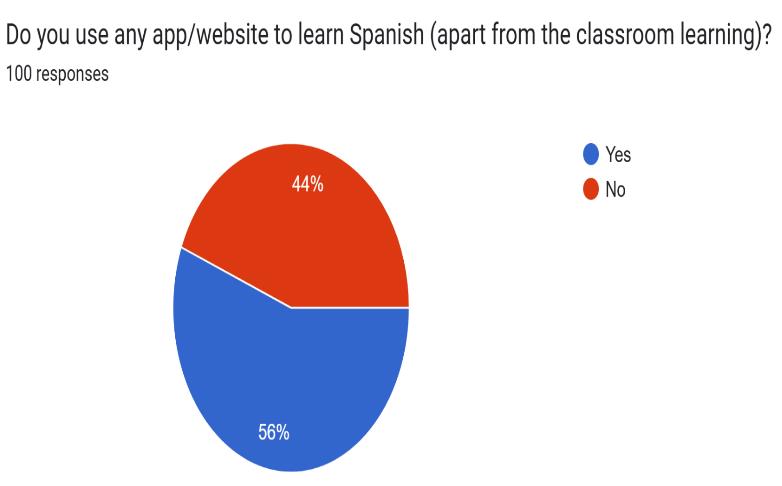
As shown in Fig. 1, 56out of 100 learners or 56% use an app/website to learn the language apart from the classroom learning while 44% solely rely on classroom learning.
The rapid advancement of AI has brought significant transformation to the field of foreign language teaching. AI-powered tools are increasingly being integrated into classrooms, offering innovative ways to enhance teaching methodologies and learner engagement. In particular, beginner-level language courses, such as Spanish, have benefited from the accessibility and personalization that AI applications provide. This paper presents a practical analysis of AI-driven tools in beginner-level Spanish classrooms, based largely on the author’s own teaching experiences, and explores how these technologies shape both teaching practices and student learning outcomes.
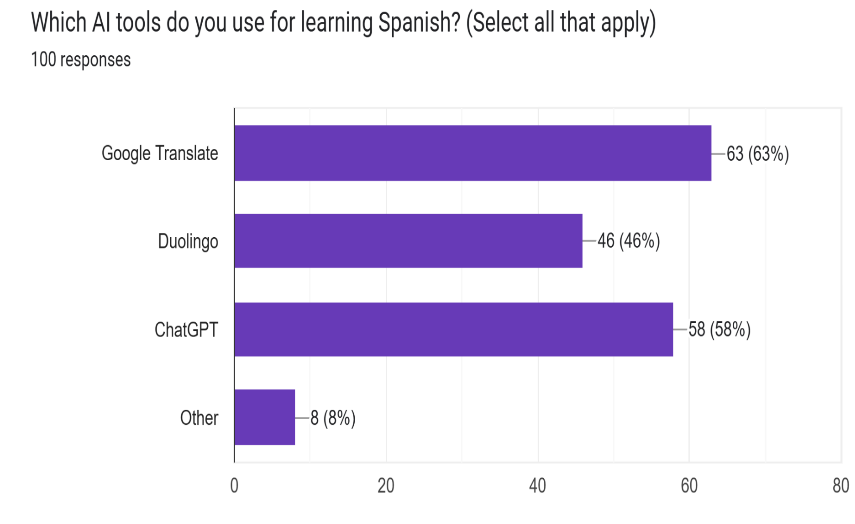
As shown in Fig. 2, 63% of learners use Google Translate, 46% use Duolingo, 58% use ChatGPT and 8% use other AI tools too for learning Spanish. It shows that learners trust most Google Translate for language learning [8].
4. Challenges and Limitations
Let's move on to the next part of the study which deals with the challenges and limitations the learners themselves feel while using AI.
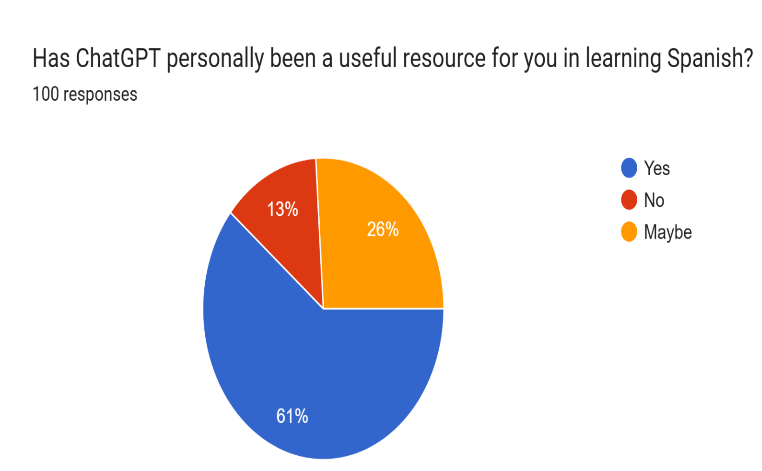
As shown in Fig. 3, 61% of learners finds ChatGPT as useful resource in learning Spanish, while 26 % are not sure about it while 13% doesnt find it usefual at all.
Despite their advantages, AI-powered tools present several challenges. A major concern is the overreliance on automated translations, which can limit learners’ ability to develop independent language skills. Additionally, AI-generated responses may contain grammatical inaccuracies or lack cultural and contextual sensitivity elements that are essential in mastering a foreign language. These issues raise important pedagogical questions regarding the extent to which AI should be trusted as a reliable source of linguistic and cultural input.
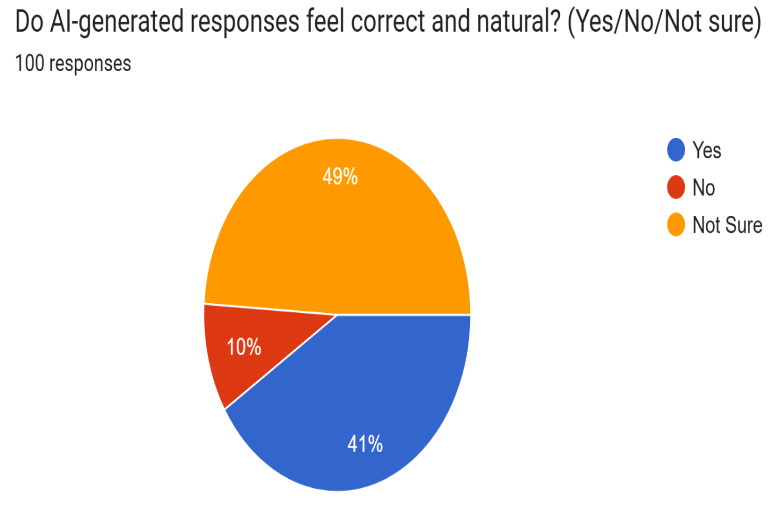
As shown in Fig. 4, 41% of learners fell AI-generated responses as correct and natural while 49% are not sure about it while 10% doesnt find it to be correct or natural.
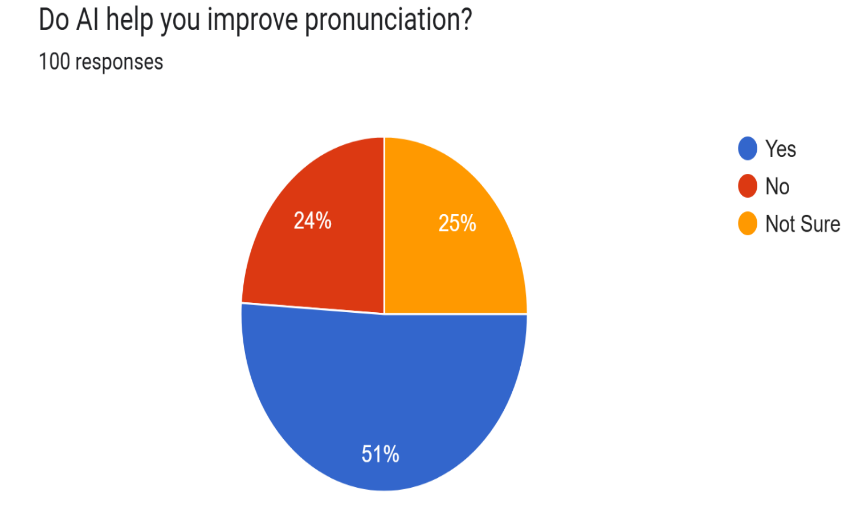
As shown in Fig. 5, 51% of learners feel that AI helps in their pronunciation improvement while 25% are not sure about it and 24% doesnt find it useful for the same. It means only half of the learners find AI useful for improvement of their pronunciation.
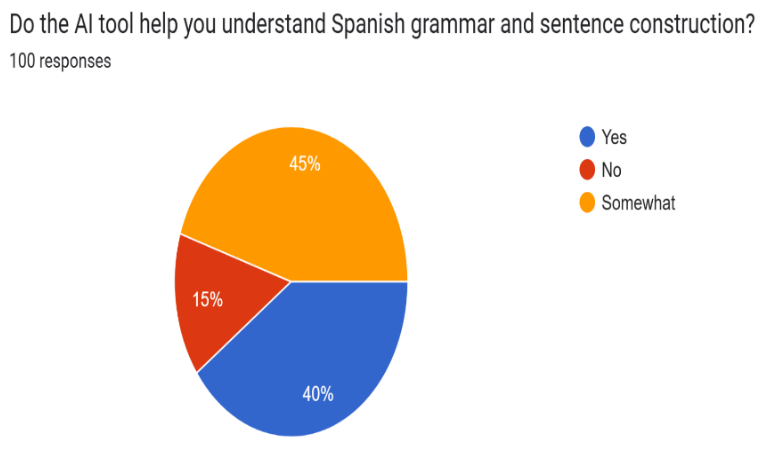
As shown in Fig. 6, 40% of learners find AI helpful in understanding Spanish grammar and sentence construction, 45% find it somewhat useful and 15% doesnt find it useful at all.
4.1 Emerging Patterns in Students’ Reported Challenges with Artificial Intelligence Use
Among one hundred subjective responses about the challenges and drawbacks students face with AI uses, a pattern was found, and the study structured them accordingly.
A major concern raised by learners is that AI lacks the ability to cater to all aspects of language learning. Respondents stated that language learning is different from other subjects as it includes listening, writing, speaking, and reading, and AI, in its current form, does not cater to all these competencies.
They felt that AI can help students understand concepts but not necessarily acquire the language [9], [10]. The subjective answers highlighted that especially among beginner-level learners, since they have very basic or near no knowledge of vocabulary and grammar, AI poses more difficulty as they get confused with the vast amount of information available.
Many respondents also mentioned that AI does not always comprehend what the learner is asking. Sometimes, it makes mistakes, which may add to their confusion.
Another common issue came across is the lack of tailored responses. Learners reported that AI responses often do not align with their specific learning needs, it may drift away from the main point or difficult to understand. Additionally, different platforms provide different pronunciations, leading to further confusion among learners [11].
Reliability was another major concern. Many learners expressed a lack of trust in AI-generated responses, feeling the need to crosscheck the information, which reinforces the necessity of a human educator. Learners also preferred human educators, particularly for grammar learning, as they felt that grammar concepts are better explained by them.
Furthermore, the respondents stated that the AI-based learning lacks real-time communication and human interaction necessary for language acquisition. Respondents highlighted that language is a medium for human interaction, and they prefer learning in real-life scenarios with actual human beings rather than machines. They didnot find AI as interactive as classroom learning and making it a one-way learning experience. Technical barriers also contribute to the challenges. Respondents pointed out issues such as access to mobile devices, internet connectivity, and the digital divide which make AI-based learning inconsistent. Additionally, learners reported that they often get distracted in the digital mode of learning.
Lastly, one respondent pointed out that feeding a prompt into AI and progressively customizing the response can be more trivial than asking a human educator which is much easier and more efficient.
5. Pedagogical Strategies
Now as the survey moved on to the final part about the pedagogical strategies, both objective and subjective questions were posed to the students, which are:
As the survey progressed to its final section on pedagogical strategies, both objective and subjective questions were presented to the students. These questions aimed to identify how learners perceive the pedagogical value of AI tools, their level of comfort using them, and their suggestions for improving their integration into classroom settings. The responses revealed a nuanced perspective: While students appreciated the flexibility, personalization, and immediate feedback that AI platforms provide, they also emphasized the irreplaceable value of human guidance in facilitating deeper understanding and authentic communication.
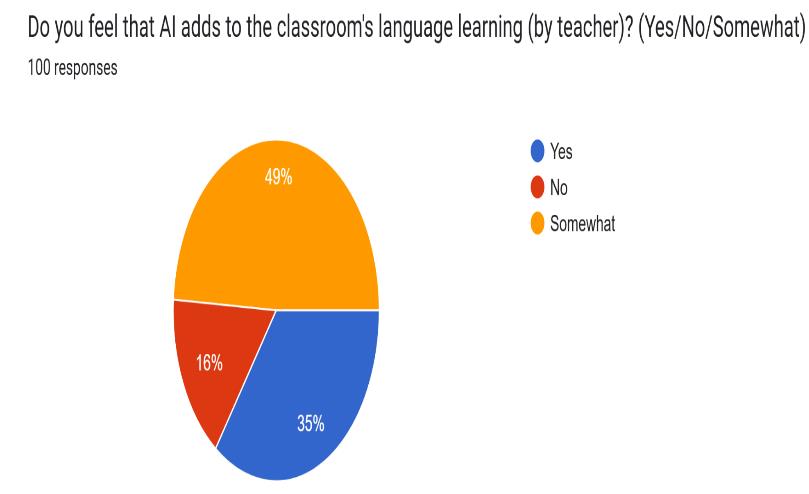
As shown in Fig. 7, 35% learners feels AI adds to the classroom’s learning by human educator while 49% feels that it somewhat adds to and 16% doesnt feels it adds to the classroom teaching at all.
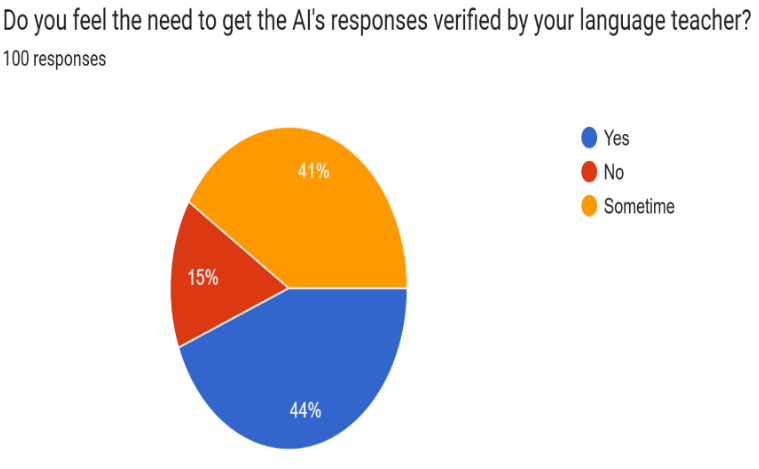
As shown in Fig. 8, 44% learners feel the need to verify the AI responses by a human educator while 41% feels somewhat about it while 15% doesnt feel to verify it at all.
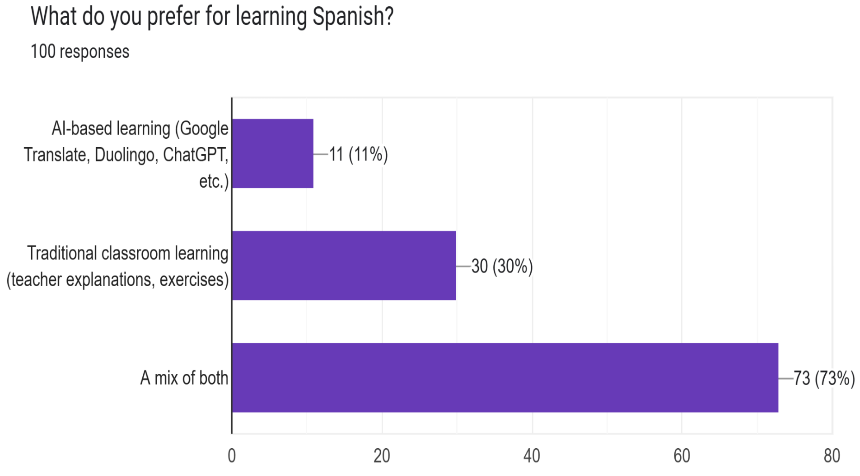
As shown in Fig. 9, 11% learners prefer AI based learning for Spanish language while 30% prefers traditional classroom learning while 73% prefers a mix of both .
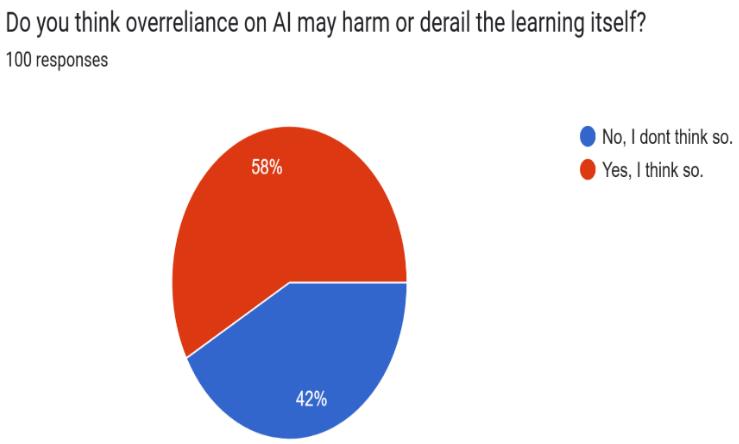
As shown in Fig. 10, 58% think overreliance on AI may harm or derail the learning itself while 42 % doesnt feel the same.
5.1 Pedagogical Implications Drawn from Learners’ Subjective Responses
The learners’s subjective responses were taken in to understand and formulate the pedagogical strategies as a way forward. It was summarized, structured as follows.
The respondents highlighted the role of AI in providing feedback and assistance. In absence of a human educator, AI tools provide instant feedback on their writings, such as paragraphs and essays. Learners found AI ideal for a quick grammar check and sentence corrections. Some respondents also stated that AI makes learning fun and interactive–they use platforms such as Duolingo as an add on to keep their learning process active.
The respondents highlighted that they see AI as a supplementary tool, not a replacement of a human educator. The respondents found AI to be a great help but not enough on its own they find to talk to real human beings, read books, and listen to native speakers to as more effective in learning a language. They found AI better for the practice part, but needed the real-world interaction crucial for fluency and cultural understanding in Spanish. Learners preferred to use AI for doing assignments, but for learning and understanding the concepts, they preffereder traditional classroom settings.
6. Conclusion
AI Under human eductor guidance for effective learning. When a learner uses an AI tool under the guidance of a human educator, they learn two things at the same time: the targeted language and how to use AI tools with precision. AI is very useful when a human educator is not available at the moment. Human educators can assign AI-based activities to keep students engaged. It can also help students to continue their learning after the class or on off days thus maintaining the momentum [12].
It has been observed that learners struggle with formulating precise prompts while using AI leading to inaccurate responses. So here the human educator has the role to guide the learners on how to use AI effectively. Also the research found out that the learners cant be left unsupervised to use AI. Unhindered use of AI may look attractive and easy for a short term but the learners may totally stop thinking on their own and critically engaging with the learning process. Here the role of human educators comes into to ensure that AI is used as a learning aid rather than a crutch.
For language learning AI is a tool within a broader learning approach. The combination of various tools is essential for an immersive language learning. A human educator has to integrate AI with regular classroom teaching, periodical movie screenings, plays enactments, incorporating songs, dance performances in the targeted language and culture, and academic seminars. AI act as a facilitator in a small part in language learning, ultimately, learners must actively participate in diverse learning experiences.
Funding
The paper received no external funding.
Data Availability
The data used and analyzed during the current study are available from the corresponding author upon reasonable request.
Conflict of Interest
The author declares no conflict of interestregarding the publication of this paper.
References
- [1] Kuddus, K. (2022). Artificial intelligence in language learning: Practices and prospects. In Advanced analytics and deep learning models (pp. 1–17). Wiley Online Library. https://doi.org/10.1002/9781119792437.ch1
- [2] Alhusaiyan, E. (2025). A systematic review of current trends in artificial intelligence in foreign language learning. Saudi journal of language studies, 5(1), 1–16. https://doi.org/10.1108/SJLS-07-2024-0039
- [3] Ji, H., Han, I., & Park, S. (2024). Teaching foreign language with conversational AI: Teacher-student-AI interaction. Language, learning and technology, 28(2), 91–108. https://doi.org/10.64152/10125/73573
- [4] Network, N. S. (2023). AI in education: Transforming learning experiences in India. https://nationalskillsnetwork.in/ai-in-education-not-just-a-trend-but-a-necessity/ National Skills Network- NSN
- [5] Huang, S., & Cassany, D. (2025). Spanish language learning in the AI era: AI as a scaffolding tool. Journal of china computer-assisted language learning, (0), 1–30. https://doi.org/10.1515/jccall-2024-0026
- [6] Seo, K., Tang, J., Roll, I., Fels, S., & Yoon, D. (2021). The impact of artificial intelligence on learner– instructor interaction in online learning. International journal of educational technology in higher education, 18(1), 54. https://doi.org/10.1186/s41239-021-00292-9
- [7] Šetka Čilić, I., Ibrulj, T., & Nujić, I. (2024). Artificial intelligence tools in a foreign language learning. South eastern european journal of communication, 6(1), 65–76. https://hrcak.srce.hr/322399
- [8] Mirzaeian, V. R., & Oskoui, K. (2023). Google Translate in foreign language learning: A systematic review. Applied research on english language, 12(2), 51–84. https://doi.org/10.22108/are.2023.134264.1949
- [9] Pradhan, R., Khan, S. A., Jegu, A., Kavitha, P., Rautrao, R. R., & Valavan, M. P. (2024). Exploring the intersection of technology and education: Artificial intelligence in language learning and communication. 2024 international conference on intelligent systems and advanced applications (ICISAA) (pp. 1–6). IEEE. https://doi.org/10.1109/ICISAA62385.2024.10828768
- [10] Tzirides, A. O. O. (2022). Smart online language learning modules: An exploration of the potential of advanced digital technologies and artificial intelligence for collaborative language learning utilizing translanguaging and multimodal communication approaches.
- [11] Berigel, M., Ayaz, A., Altinay, F., Altinay, Z., Dagli, G., & Shadiev, R. (2024). Exploring the intersection of artificial intelligence and disability in education: A thematic analysis. 2024 IEEE international conference on advanced learning technologies (ICALT) (pp. 147–149). IEEE. https://doi.org/10.1109/ICALT61570.2024.00048
- [12] Yang, S. J. H. (2021). Precision education-a new challenge for AI in education. Journal of educational technology & society, 24(1), 105–108. http://index.j-ets.net/Published/24_1/ETS_24_1_08.pdf